Sunday, 25 May 2014

An abiding image ...

Eastertime 1962

That day in April
I left my grandparents’ house
and walked to the river,
the majestic St. Lawrence.

Beside it sheep grazed,
their paddock filled with yellow daffodils:
yellow beyond yellow,
green beyond green.

Willow trees arched over the low stone walls,

their branches veiled against the blue-sky sunshine:

I walked on to where a young boy was fishing.

As I watched, he hauled in his catch:
not the delicate silvery fish I was expecting
but a long, thin, black creature,
the embodiment of a hiss:
S-shaped and angry,
muscular, coiling, wrestling on the hook.

How could such a thing be in that water?

The sheep, oblivious to menace, kept their heads down.
But I kept watching that startled boy and his writhing fish.


© Lorna Harris
May 5, 2014


I wrote this poem as an informal assignment for the final Spiritual Direction intensive at Mt. Carmel. At the previous intensive last fall, Cathy Smith-Bowers asked each of us to choose a colour or have a colour choose us and, using it, find an abiding image as the basis for our poem. I struggled with yellow all winter as I did not feel at all yellow. Several days before we were due to be in Niagara Falls I wrote this. You would hardly guess that yellow was the colour, would you!

The poems of the other members of my group were really wonderful, and I venture to say, none of us considers ourself as a poet. But of course, somewhere inside, we all are.

Tuesday, 15 April 2014

We watch The Wolf of Wall Street


With nothing else on television last night, Greg and I  decided to use the On Demand feature in our cable package for the first time. We chose The Wolf of Wall Street figuring for $5.99 we could turn off the television and go back to reading our books, and not have wasted much time, money or energy if we were too shocked and appalled to watch very long.

Much as I hate to admit it, I found it very funny. What on earth is wrong with me? It’s raunchy beyond belief (well my belief, anyway), misogynistic, violent, and laden with scenes of illicit drug-taking. The so-called hero — convicted swindler, money-launderer and erstwhile stockbroker Jordan Belfort, played by Leonardo di Caprio — gets away with it, more or less. He does have to spend a few months in an upscale prison post-conviction, playing tennis a good deal of the time, poor fellow, before reinventing himself as a motivational speaker.

This movie, directed by Martin Scorcese,  reminded me of Pulp Fiction, Borat and Catch Me if You Can (where Leonardo di Caprio was directed by Steven Spielberg). There is even a hint of A Fish Called Wanda both in the goldfish swallowing scene and in the unholy desire of this audience of two to see what the villains would get up to next. These movies involve trickster figures: mischievous, rascally, really bad characters devoid of guilt, shame or restraint.  Their behaviour is sent up by the movie-makers almost to the point of farce.  Black humour abounds.

I was expecting a much darker movie along the lines of No Country for Old Men (the character played by Javier Bardem is terrifyingly wolfish) or of Glengarry Glen Ross, which portrays the cut-throat, amoral aspect of sales as very definitely unfunny.  Most of the dark aspects in The Wolf of Wall Street  are either alluded to only briefly (the bathtub suicide) or occur to other unlikeable characters (the butler hung over the balcony). You know that if the butler had fallen, it wouldn’t have been intentional, but just a big mistake. It was cartoonish.

The only time in the movie I felt a quiver of genuine fear and misgiving occurred when, after a fight with his wife,  Belfort kidnapped his own daughter, placed her in his car and tore out of the garage in reverse, only to hit a tree in the front yard. He was stopped before too much damage was done. Shades of Tiger Williams and his misadventures, sexual and automotive.

Another reason I liked this movie was that having spent four unenjoyable years in insurance sales in the late 80s, I was reminded all too vividly of learning the art of the sales pitch. It’s not about the product: it’s all about the buyer and motivating their desire. I loved the contrast in the two scenes about the pen. Those Australians—or were they New Zealanders? — attending the motivation seminar at the end of the movie sure have a lot to learn.

When you watch the stock brokers in action in this film, you are given a sense that they swindled so egregiously well  because their victims were as greedy as they were for easy money. Not a lot of sympathy is extended to them.
 
This was more of a caper movie than a particularly serious reflection about greed, self-promotion and moral decay.  If you want a more sobering look at Wall Street, watch Margin Call (2011) written and directed by J. C. Chandor. Or remember Renata Ford's expression when Rob Ford apologized on camera for his comments about his sexual preferences and drug use. No stiletto heel in the face there. That  news conference was not funny in the least.

Tuesday, 15 October 2013

Of Juliet and her Romeo

We went to Stratford last Friday night to see Romeo and Juliet,  Shakespeare’s second tragedy. Directed by Tim Carroll, It was a good production, though not brilliant. I liked the way the actors came on stage at the start chatting to the audience about turning off their anachronous cell phones and Blackberries or whatever. Then the chat continued and imperceptibly became Shakespeare’s text.

Several things struck me as I have since thought about the performance. One  was the  motif of wounding. What interplay of metaphor and realitybeing pierced by Cupid’s arrow as if slain or being fatally slashed by a real rapier. Love is like being struck to the core by a surprising transformative creative reality; hate and conflict can result in death which is real and literal. The two uses of language culminate in Juliet’s suicide when she falls on none other than Romeo’s  dagger. Her love for Romeo literally kills her. I feel I am not expressing this concept very well, but I’m trying. My metaphorical development stalled at about age three. However, Marion Woodman's has not; on p. 24 of The Ravaged Bridegroom, she says metaphor yokes together matter and spirit "without bloodshed."  There is a huge difference between self-murder and Self-sacrifice, which, tragically, Juliet and Romeo do not understand.

Another thing I noticed was everyone’s noting Juliet’s youthfulness. Sara Topham’s portrayal of the thirteen year-old Juliet was somewhat on the histrionic side at times (much arm flinging), but then some adolescent girls tend to be like this.  In any event, I concluded the play should be more about her than anyone else. This was not something I had considered before.  Of course the last line suggests this:  a story about “Juliet and her Romeo.”  The inverted order of the names may not have been intended only to make the last line rhyme with “woe.”  Perhaps Shakespeare wanted to emphasize what Juliet represented in the unruled hyper-masculine society depicted in this play.

Juliet is so much like Miranda in Shakespeare’s late comedy, The Tempest —very young and completely innocent of the ways of the world, both the personal world and the public sphere. Unlike Miranda who has a wise father and a suitor willing to undergo challenges to win her, Juliet has parents who are horrible to her, and she lives in a society which is torn apart by testosterone gone wild. Juliet’s fate is practically a foregone conclusion.

In thinking about the contrast between the destructive masculine and the neglected feminine, one line stood out for me: Romeo, played by Daniel Briere, criticizes himself for letting love make him effeminate.  He soon displays the same savage vengeful behaviour as his peers and by the end of the play is a double murderer.  If I had cast (or directed) Romeo, I would have preferred a slightly more worldly-wise youth at the beginning; after all, his gang buddies have been his friends for a long time. He knows his world and is only temporarily thrown askew by love, first for Rosaline, then for Juliet.

Psychologically he is like a lot of teenage boys who are so overwhelmed by their first experience of falling in love that they draw back. Alas, in the world Romeo inhabits, this regression involves participating in blood feuds of which no one can remember the origin. And this is the natural world for him. He should be depicted a somewhat more cynical lurking character when he first sets eyes on Juliet.

Romeo is caught between the two worlds — the machismo of the blood feud and the better angel of his nature, symbolized for him by Juliet.  But unlike Ferdinand  in The Tempest, he does not undergo trials to prove his worth to his beloved or to her father.  He swings between the opposite poles of self-annihilation and annihilation of others. Not only that, one wonders whether, once he gets over his infatuation with Juliet, will she just be cast aside like Rosaline?

And Juliet, who, unlike Romeo, is not experienced in love will suffer that loss eventually.  In this she reminds me of Ophelia — another Shakespearean heroine left to twist in the wind by her beloved and by her father.  In trying to understand his murderous  behaviour and to rationalize it, Juliet twists logic and concludes he had to kill Tybalt or Tybalt would have killed him.  She can then continue to idolize Romeo.

So what was Shakespeare trying to say in this play?   It is a commentary on the futility of hatred and vengefulness (it was Shakespeare’s next play after the bloody Titus Andronicus), but it is also a coming of age story about a young girl. Unlike the characters in A Midsummer Night’s Dream, who wake up out of the spell cast by the complex of love and then love more sensibly, Juliet lives (and dies) in unthinking adoration of Romeo.

The play was so much darker than I remembered — despite the house lights being turned on for the whole performance owing to Original Practices staging.  My immediate response is that being wife to Romeo could eventually be like being married to Tony Soprano.

Mind you, one should re-check one’s initial impressions, so back to the text I shall go. I have put re-reading Romeo and Juliet on my Read This list.

Friday, 30 August 2013

World premiere of Evangeline rocks

Usually I don't go out of my way to see musicals. If a friend or relative is in one, I'll make an exception, but there is something about people breaking into song and dance  at the slightest impulse which baffles me - well, unless the musical is about song or dance, then that is different. I enjoyed Billy Elliot (dance ) and 2 Pianos 4 Hands, but goodness, maybe the latter was not actually a musical but piano playing and great lines. Jersey Boys  and Abba had great songs; I enjoyed them.

I do remember seeing the Sound of Music several times when it first came out, mostly, I expect, to savour Christopher Plummer. Having just read Jane Eyre, I was awash in a Mr. Rochester complex.  I  thought the hills really were alive with the sound of music which says more about my taste (musical and otherwise) at 16 than I would like to admit.

However, Greg and I made the hour-long trek into Charlottetown last weekend to catch a matinee performance of Evangeline at the Confederation Centre for the Arts. Several friends had highly recommended it. Ted Dykstra wrote the book, lyrics and music. The program reminded me he had co-created 2 Pianos, 4 Hands, so my expectations were raised. I was not disappointed. As it turned out, I really enjoyed it.


The front page of the program was illustrated by Steve Adams.

The story is based on Longfellow's epic poem of the same name and recounts the expulsion of the Acadians from the Maritimes (specifically from Grand Pre, Nova Scotia in 1755). A century or so later, this region would be coalesced along with Quebec and Ontario into the Dominion of Canada.

From the Enrichment Guide, the painting of the 1755 expulsion  is by Claude Picard.

This is a great production of this little known, but shameful story. Canadians today can get off the hook by noting this happened when the British were running North America and were embattled with the French (and soon the Americans) for control of the continent.


Nevertheless, the themes of displacement, unfairness, prejudice, and callousness ring true on a deep level. We are reminded of other populations and races suffering similar horrors. Families, deported to various destinations in the British colonies to the south and to the French colony of Louisiana, are  separated never to see one another again.


Another painting by Claude Picard is printed in the Guide.
 
Conditions aboard the ships are  recounted in letters home read by Lt. col. John Winslow, the English commander (played by Laurie Winslow). The decks in the hold are only four feet high and the human cargo is allowed up on deck for fresh air only infrequently. Not surprising the mortality rate is high. The colonel can't understand why they are seen as a threat to the Crown.  Others are not so sanguine and there is a cast of non-Acadian characters who range from indifferent to dangerous.

However, counterbalancing the desolation and loss of home are the universal themes of undying love and the lifelong quest for the lost beloved. Newly married Gabriel Lajeunesse (played by Adam Brazier) and Evangeline Bellefontaine (Chilina Kennedy) are sent on separate ships to different destinations.


Gabriel, believing Evangeline has drowned, becomes a wandering trapper; Evangeline is certain he is alive and the story is her quest for him. I like the idea of a woman on a quest. Usually the hero is male.  She has spunk and determination and compassion (kind of a toned-down Lizbeth Salander or Katniss Everdeen).

Especially poignant are the scenes where Evangeline and Gabriel share the stage but are not aware of one another and sing a duet in which they express their sense of love and loss.  A lot of audience throat-clearing occurred here, and the man beside me was mopping his cheeks with his handkerchief.

Oddly, for what I expect is a largely secular audience, the religious imagery and themes are not played down (reminded me of Les Mis), but the book is true to Longfellow's poem and Acadian life, as well as raising other issues around the advisability of turning the other cheek.

The stage setting is a series of huge images and maps projected behind the actors. It's very effective. A rapidly moving red line shows the path of Evangeline's wanderings over many miles and many years.

An orchestra provides the accompaniment, and the actors aren't overly - or overtly - miked. As a result, the sound quality, as distinct from the songs themselves (which are very good), is not so overpowering that you have to block your ears.

If I had a criticism of the production, it would be that the scenes at the start showing the idyllic life in "Acadie"  go on a bit too long  and the use of a sort of pidgin English when the Acadians were talking to  English speakers is jarring.  These are minor, and not everyone might agree with me.

Apparently Mirvish Productions had to give up on the production in Toronto as it was becoming  too expensive to mount so Dykstra moved it to PEI - a brilliant move for a world premier, which touches the lives of many people here who are descended from the first Acadians.

If you get a chance to go to see this production, do so. Toronto's loss is Charlottetown's gain.


Claude Picard's rendition of life in "Acadie."


Thursday, 1 August 2013

In which I bake bread the Chef Michael Smith way (almost)

 
Last night we went to the Fortune Community Centre for a fund-raiser in its benefit. Monday night bingo doesn't seem to be profitable enough. Expenses are on the rise. Even last year's boobalicious bingo (!) appears not to have drawn the crowds ...
 
Anyhow, Chef Michael Smith volunteered to help raise funds. Yes, that Michael Smith of the Food Channel, which is not on our cable subscription at home, so I am not that familiar with him, but he is, I observed last night, both very tall and very talkative, which is good when making a presentation.
 
You could have some time with him in a small group for $40 each or be part of hoi polio for $25. We chose the latter and got there 10 minutes late. The event  had, to my surprise at any rate, already started. Chef Michael talked about eating properly and that home cooking was not all that hard or time-consuming.
 
He had a cookbook to prove it, which Greg bought for me:


He also sang the praises of local food, especially PEI delectables. We all received goodies, including mussels steamed in the parking lot, many varieties of chocolate chip cookies made by the ladies of Bay Fortune, and slices of home-made "Country Bread,"  made with Red Fife flour milled in New Brunswick (and available locally at MacPhee's Save-Easy, I was told, when I raised my hand during question period and asked).
 
http://en.wikipedia.org/wiki/Red_Fife_wheat  This link is very enlightening - likely more so than this blog!
 
We also received a bag of "Country Bread" ingredients.While we  did a count-down, Chef Michael made up a batch in 60 seconds.
 
Four ingredients only: water, flour, salt and yeast.  The assembly took no time at all once everything was mise en place. But, why no sugar? The reason is that the dough is left overnight for the yeast to work. This means no preliminary kneading - a step saved. 
 
I thought I would try this for myself. I must admit I cheated a bit as the bread last night tasted a bit flat to me. So I added  a tbsp. each of molasses and vegetable oil. The molasses was not Crosby's from Newfoundland, which is  about as local as you can get for molasses around here, but was President's Choice from Ecuador. At least it was from this hemisphere.


Like Michael, I used the handle of the wooden spoon (cousin Cynthia gave me mine) to stir it. A spurtle would likely work just as well:


That's all: just cover with Saran wrap (no idea where it was made) and let it sit overnight.


I was up at just after dawn - 5:58 to be as exact as my clock radio. The sun was just up:


Freddie dog was awake too, but barely:


I checked the dough. As promised, it had doubled in size!


It was a bit early to make bread so I went back to bed where I stewed about its over-rising until 7:00 when I got up and made it into loaves.  I did knead it a bit as the recipe suggested and let it rest while I greased the pans:


Then into the pans to rise for 40 minutes and thence the oven - at 380 F, not 425 F as the recipe suggested!


I wish I had put it in at 350F since one loaf rose rather oddly into a hump in the middle - good for Humpday, which my Facebook friends were celebrating yesterday, but two days late for me.


Nevertheless, I sliced it while warm and ate some. Delicious!  I will try this again! It's so easy having it rise overnight!


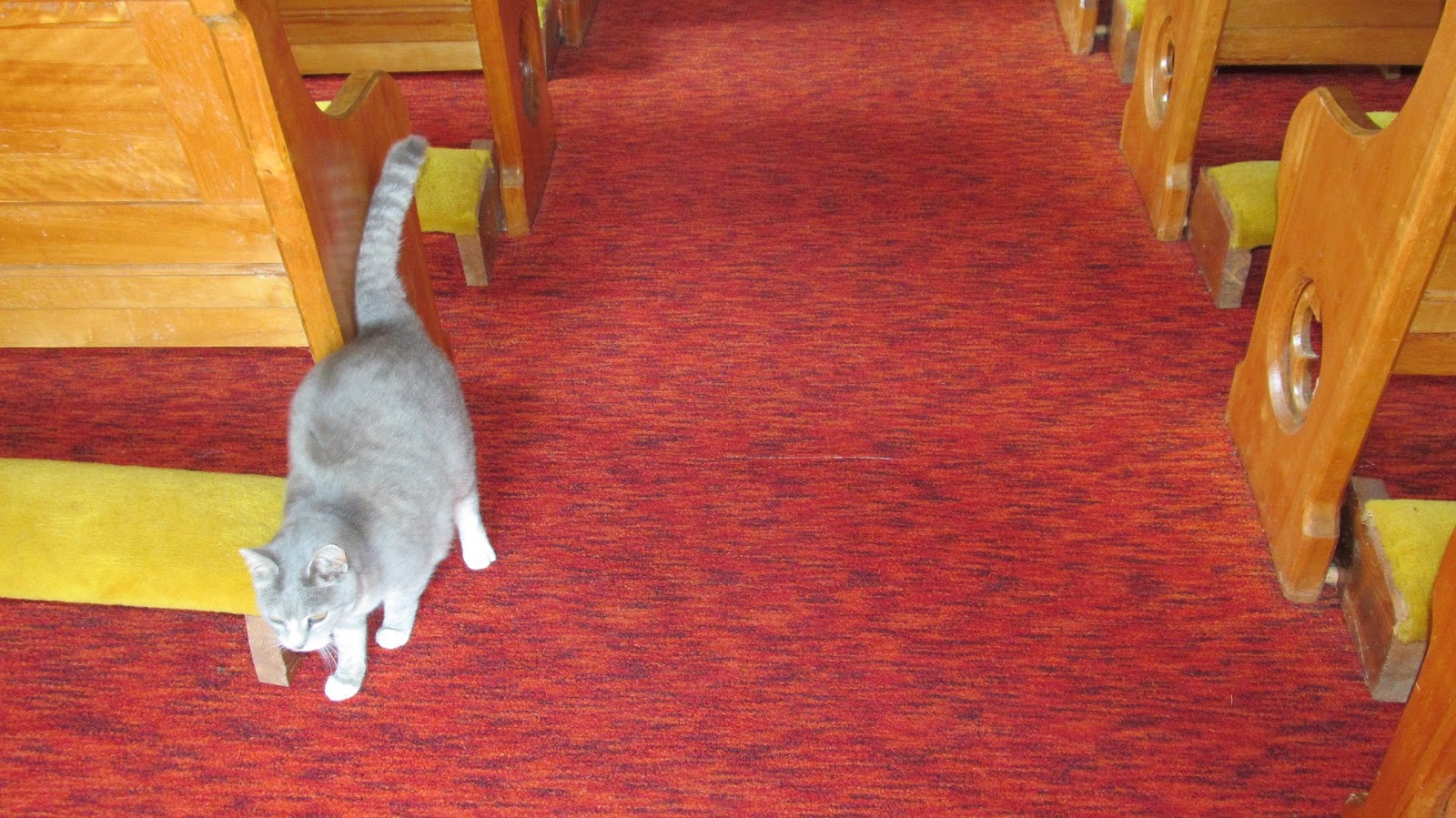
In which Silver goes to church

A couple of Sundays ago, Greg and I went to St. Alban's in Souris so that Greg could preside at the service that morning. It is such a wee tiny church.


Since we were early, I wandered around the cemetery looking at the gravestones.


Soon I was joined by a small tabby cat.


which seemed to know just here she was going.


Yes, off to church:


Greg was inside setting things up and generally getting ready.


No water for the wine! A human congregation member - the warden, in fact - feeling it would be inappropriate to get a glass of water from the restaurant right across the street went off to "the store"  for a bottle of same. Would that have been the Co-op, the variety store or the Save Easy?
 
 
Meanwhile, decisions, decisions: which pew to choose ...


Aha, right at the back - very Anglican -


But before settling in, some more exploration would be fun. If only the organist were here, we could play a duet:


or I could help Greg with the prayers:


It seems I am not needed in the chancel:


This seems to be a comfortable pew:


Nice service, great hymns, thought-provoking sermon, I enjoyed the service. Now home for lunch:


Apparently Silver the cat has been in the habit of attending church for quite a while. At a recent service, she joined the priest at the front, and he picked her up and lead the congregation in singing All things bright and beautiful. I am sure she enjoyed the impromptu serenade.

At this service, she visited each pew during the sermon and of course was patted by everyone.


Alas, her people are moving, so Silver will have to join another congregation soon. She will be missed.

 
But St. Alban's doors will be always open in case she want to return.


Thursday, 25 July 2013

Wild Flowers of Eastern Canada is on the bookshelf after all

I am loathe to throw things away. Once you do that, it seems a use for the forsaken article eventually or, what's worse, immediately crops up.

And I am even worse with books. Periodically I cull the shelves and send two or three to a garage sale, then usually end up returning home with them.  Why wouldn't anyone want a 2004 Tourism Guide to Saskatchewan? It's a mystery.

As I related in my last post, I am making a path in our meadow and have had the opportunity to get up close and personal with a variety of anonymous wildflowers. Well, unnamed they are no longer.

Friend John suggested I should look up the names of the plants and lo and behold, almost hidden on the book shelf between Pierre Berton's Cats I Have Loved and Known and Loved and Anthony Trollope's Barchester Towers ( both fine cottage reading) was what I was looking for: Wild Flowers of Eastern Canada.

Yes, I did pack a field guide after all - and not just any field guide, but one made even more beautiful by the watercolours (executed by Katherine Mackenzie), which adorn its pages.
 
 
And only $2.95! 


Apparently it was published by Tundra Books in 1973 and purchased by my mother for us in 1977. As I recall, we were living on the military base at Downsview at the time, and there was a large field behind the house.
 
The standing orders seem to have allowed for a fair growth of "weeds," as a photo of our daughter as a toddler, sitting surrounded by dandelions, attests. And at that time, Gran and Granty gave us this little book "to enjoy the many wonderful things in the great outdoors."


It seems to have become son Tony's acquisition given his initial in masking tape on the front cover and his name in his four-year-old handwriting:


Today I leafed through it and found a whole page devoted to just what I saw yesterday: buttercups, red clover, clustered bellflower  and cow vetch (aka bugle weed?), which apparently tastes like honey (and bovines love it).


It is a small volume, I can easily tuck into my pocket long with my camera. But it is more than a handy reference for wild flowers. It recalls to mind a time 40 years ago when the children were still small and at home in what must have seemed like an enormous world bounded by trees, a field, and the houses of little friends now long forgotten.  What happened to the other Robbie, to Tony's friend Cass, to little Alison, the same age as Joanna.
 
And their grandparents, so much a part of our lives at that time:  my dad deceased for almost 25 year and my mum now almost 95 and settling in to life in a nursing home.
 
They're all called to mind while I am leafing through this book and its watercolour reproductions of 100 wild flowers in "90 full color plates."